
Rory Waterman‘s fourth volume by Carcanet, Come Here to this Gate, is an unusual and resplendent three-part collection that saddens, amuses, and sticks rigidly in the mind.
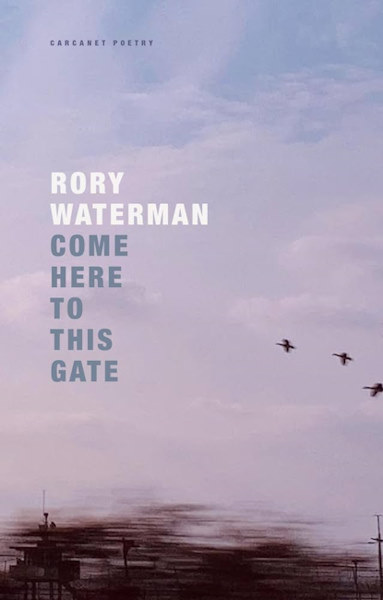
The volume begins with a sequence that charts the difficult final year of the poet’s father, Andrew Waterman, marked by alcoholic dementia and disability. A second section of miscellaneous poems considers the construction and destruction of borders and boundaries, both figurative and literal. A third section of reimagined Lincolnshire folk tales is coarse and captivating. The three seem unlikely bedfellows on the surface, but together they prevent the volume from drifting too deep into the maudlin, the activist, or the downright absurd.
The first section is the most gripping and compelling. There have been hints and personas in Waterman’s previous volumes around family and upbringing, but this, marked by closure, is much more transparently autobiographical. The sequence of twelve poems is roughly chronological, interrupted by occasional interludes that look back towards childhood days.
The poems steer the observation calmly and quietly among the father’s visceral outbursts in unsettling hospice settings, one of God’s many waiting rooms. They explore mental and physical ‘presence’ – what it means to be ‘there’ and to be aware. There is an ineffable tenderness to the telephone calls which fall into silence, and a pathos to the tugging of the bedside light at bedtime. A lyrical quality emerges from the endlessly repeating patterns of speech, ‘I’ll … I’ll … I’ll … but I don’t … and I don’t … and I don’t’ (IV), which are themselves from endlessly repeating cycles.
Waterman’s laconic tones are ideal for reflecting upon the most pressing of human challenges, a mainstay of his work but most acutely felt here. At certain moments, the poems evoke pity, at others, pitifulness. Dad’s nappy fills as he imagines an idyllic scene – ‘and this is dignity’ – immediately disturbed by the snoring from a neighbour’s bed (I). Elsewhere, we find the poet-speaker ‘lacking heart, or having one, or both’ (VII), entrapped by the debilitating and guilt-laden impact of dementia. In some circumstances, perhaps people can survive too long.
It’s only by the time we reach the coda that it feels remotely elegiac. ‘As you weakened, I was company / and so were you.’ I’m reminded of Jahan Ramazani on modern elegy (a book I encountered for my very first undergraduate essay): that it ‘offers not a guide to “successful mourning” but a spur to rethinking the vexed experience of grief in the modern world’. Yes, it is vexed, and sometimes slow, sometimes numb; not always given and not always warranted.
So much is felt within and without these poems, and much is gained from their existence.
The second section covers a broad spectrum around borders and boundaries, from the acutely personal to the global and geopolitical.
‘Come Here to This Gate’, which shares the title of the volume, is taken from Ronald Regan’s 1987 speech in Berlin, shielded behind screens, inviting Mikhail Gorbachev to ‘tear down this wall’. The poem cleverly frames a series of simultaneous set-pieces across psuedo-neighbouring borders, some reflecting stages of peace, others reflecting stages of conflict. Do borders offer safety, autonomy and sovereignty, or are they liminal structures behind which very little differs? The poem poses interesting questions amid a darkening rhetoric in the UK and Europe around border control.

It is of no surprise, given my work on boundaries and enclosures in the work of the seventeenth-century poet Andrew Marvell, to see explicit nods to him in this volume. ‘Time’s wingèd chariot’ becomes a wary cliché in a witty and slightly claustrophobic poem about lockdown routines and feeling semi-officially trapped. As someone who sees the boundaries within ‘To His Coy Mistress’ as a route to frustration and failure rather then hope and seduction, I feel vindicated to see that same quarrel here too, in this most unusual of modern contexts.
Meanwhile, ‘Anniversary’ harvests and modernises Marvell’s conceit from ‘The Mower to the Glow-Worms’ (conceivably written during a spell at the Yorkshire country estate, Nun Appleton) to register the same displacement at a Lincolnshire golf club. In Marvellian fashion, the setting is idyllic, the contentment is compromised, and the ambiguity is delightfully poised. ‘You wanted nothing else / I wasn’t ready to take the risk’ is a teasing yet loaded cliffhanger that invites us in before shutting us out.
Many of the poems in this section capture similar essences: dissatisfaction, extra-marital affairs that get messy (Morality Play), as well as scenes of loss and heartbreak (Perennials, At a Friend’s Second Wedding, Delayed Postscript) – all beautifully observed. The outwards study of humanity turns inwards for a poem about social media prompts for celebrating memories. Here, Waterman’s treatment of his father’s condition is more abrasive, as he spies a childhood photo of the pair in a location he doesn’t recognise and grimaces that he cannot ask him about it: ‘your mind’s a shower / of splintered glass I can’t repair’. The digital image feels subliminally transposed to a glass photo frame in order to generate a parallel metaphor for the breakdown of the brain. We’re drawn to contemplate how some memories are pleasant, others meaningless, and some become just too complicated when we’re reminded of them.
This inwards turn to the power of suspended memory takes on a whole new depth in ‘The Stepfathers’, a subtle and unobtrusive poem that packs the darkest story and the volume’s most disturbing twist on boundaries.
Panic took him to church, to cross himself.
Not again tonight, and she’ll forget.
Just a glimmer of the trauma is all we need. Closed doors remain closed doors. It’s a commonly known adage, ‘show, don’t tell’, but Waterman’s great art is knowing what to share, as well as how to share it.
The third and shortest part of the volume is a set of four Lincolnshire folk tales reimagined for modern times. Yallery Brown, the first of the four, as well as the longest and crudest, feels like a real Ovidian shift from what has preceded it. The mischievous boggart, ‘a garden gnome slathered in crap’, is dialled up to eleven, as a farting, prancing, wank-waving menace.
In the original tale, the boy who requests magical help with his work ends up losing his nerve when folks grow suspicious about his unexplained powers. In this retelling, we get the angry old boss intervening. ‘Where have you been, you lazy young bastard?’ The quatrains roll along quickly and effortlessly. The profane is no less celebrated than the profound.
The Metheringham Lass and Nanny Rutt have darker undertones. The Metheringham Lass is a siren-like ghost or spectre who lures occasional men off the moonlit road to share a smoke or a spliff. We’re left unaware of whether a fatal accident is coming to mirror that which she may have succumbed to herself, but it feels foretold that it might. Nanny Rutt charts yet another affair that goes wrong, with an interfering witch who warns the woman about the man she’s eloping with and later reappears when that warning goes unheeded. A tale with no redemption, we’re told. It’s like an 18-rated version of the 2012 film, Brave.
The fun in these tales is extremely tangible, though it’s also interesting how the character types and scenarios align with the themes, vices and flaws we see elsewhere in the collection.

Across Waterman’s first three volumes, the traces of nostalgia seem to increase as the personas grow older. His debut collection, Tonight the Summer’s Over, finds students whose family home has changed, an inexperienced council worker who helps to clear a dead man’s flat, the anticipation and apprehension of the unknown in relationships. Sweet Nothings finds a sceptical older view of ‘the university of life’ amid the stumbling career of fictional lecturer Bob Pintle. In ‘Leavers’ Balls’, the epicentre of a man’s life is traced back to his school prom, which his own son is about to experience. The opening poem of the volume gambits in conclusion, ‘A parent’s age’. Indeed.
The forced and circumstantial closures that characterise Come Here to This Gate – death and Covid and lockdown – bring more immediacy. The memories and conversations feel fresh and raw and biting, even as they often deal with memory loss. This in turn lends more piquance to the moments of nostalgia, such as the interludes that cast an ever-increasing distance back to childhood. There’s a knowing maturity to the observations and storytelling that only lived experience can bring.
Just over 100 years ago, T.S. Eliot celebrated Marvell’s verse for ‘an alliance of levity and seriousness (by which the seriousness is intensified)’ as characteristic of his wit. There’s something similar to be said for what Waterman’s verse now achieves. The poems are never tragic nor sentimental, and the text rarely dwells. Rather, its wit and lightness of touch belies an often bleak subject matter. But the poems are an art in suspension and always leave us thinking – of opportunity, oversight, regret, and loss – and then thinking some more.
And for that, I am truly thankful.
Come Here To This Gate is available via Carcanet and other major retailers.
Related posts
Tonight the Summer’s Over
A review of ‘Tonight the Summer’s Over’, the debut collection from Rory Waterman.

Epic Fail: Andrew Marvell’s Definition of Love
At the time of the year when we are drawn to reflect upon companionship, a look at seventeenth-century poet Andrew Marvell’s way of coming to terms with its absence.

Would Marvell approve of Tinder? A response to Cosmopolitan
The seventeenth-century poet Andrew Marvell received a mention in a recent Cosmopolitan article about Tinder. Would he really have approved of it, as its author claims?
Broken Dreams: Marvell’s Poetics of Privacy
Writing the final chapter of my thesis has been traumatic. The internal negotiations that Marvell faced and the impossibility of choice he so often found himself with leave him trapped in a life that offers so little solace.
 Writing Privacy